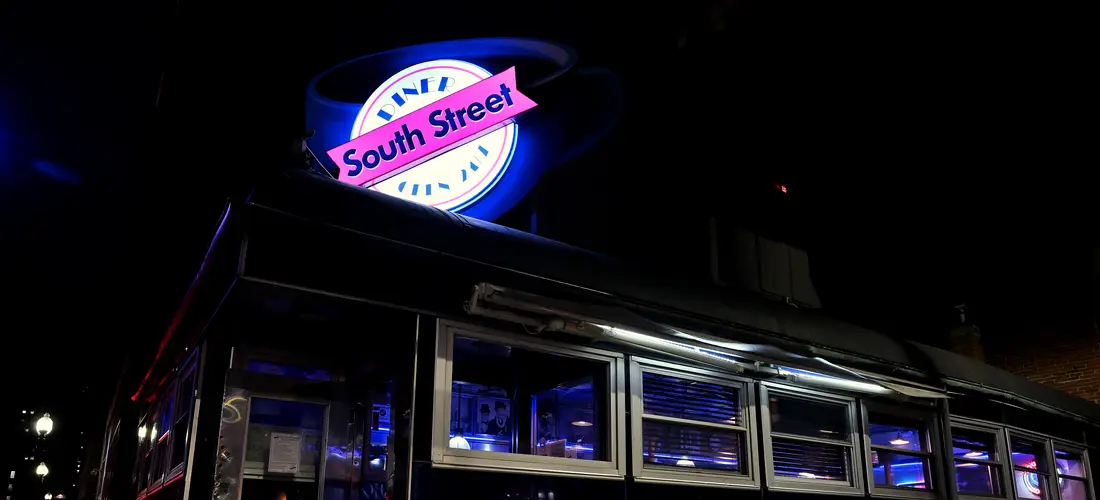

Last call has come and gone, the bars are dark, and you want eggs. Boston's answer is short and well rehearsed. There are only two 24-hour licenses in the city, according to a Boston.com guide, and that is the whole list. One is a diner, one is a bakery. For a city of this size that is not a food scene, it is a fallback plan, and the reasons it shrank are more interesting than the two survivors.
The two that are left
South Street Diner is the one most people know. Sol Sidell, who has owned it since 1997, does not buy the idea that Boston has no night owls. He told the site that some of his busiest hours fall in the middle of the night, filled with bar-goers and graveyard-shift workers. He added that many of those orders are takeout, a shift tied to COVID-19.
Bova's Bakery on Salem Street in the North End is the other. A 2018 Boston.com guide says it opened in 1926 and serves bread and pastries at all hours, day and night. Bakeries also sit under a lighter rule. The Licensing Board says almost all food service businesses need a common victualler license, but bakeries with no seating do not.
A counter that sells bread is a simpler business to keep open than a room with tables and a grill, and that is the shape of the survivor list: one diner, one bakery.
What used to be open
A lot, apparently. The Boston Preservation Alliance writes that Charlie's Sandwich Shoppe in the South End, a diner that opened in 1927, was open 24 hours a day, 7 days a week, for its first 32 years. The original closed in 2014 after an 87-year run and reopened two years later under new ownership.
An older Boston.com list of all-night spots reads like a different city. It found a Cambridge Clover open around the clock. It also found a donut shop whose drive-thru ran 24/7. And it found a diner that stayed open all night on Thursdays, Fridays and Saturdays. Six years later the same outlet's count was two licenses. That is a drop we can document and not explain with one cause.
Why it dried up
The reasons come in two layers: what the city does, and what the industry does.
On the city side, Boston.com's list of reasons residents give starts with the T not running late. The list goes on to strict liquor license laws and rising rents. We cover the first and last in our pieces on late-night T history and the license cap.
A restaurant owner, Redd, told the site that the city has long leaned toward restricting late nights. On the industry side, the same piece says the pandemic left restaurants struggling to hire people for late shifts, while costs pushed them to cut hours. Our read is that bars face the same math, and it is why the kitchen so often closes before the bar does.
It is not only Boston. A 2025 Yelp analysis cited by Fox News found 24-hour restaurants in the U.S. fell 11 percent in five years. A food-industry writer attributes the trend to hiring for overnight shifts being hard to justify when business is slow.
Who is trying
The city has a director of nightlife economy, Corean Reynolds, who says her job is to show businesses how to extend their hours. The example Boston.com gave was a halal spot downtown that now stays open until as late as 4 a.m. some nights. Her office stepped in after late-shift firefighters said their meal options downtown were thin.
The mayor's office has talked about a late-night food truck program as part of its nightlife push. This summer the mayor credited it with creating new jobs for the late-night workforce. We do not have a schedule or a list for it, so treat it as a program to watch.
During the summer's extended-hours pilot, one hospitality group noted that fine dining benefited too. Its beverage director said later seatings picked up, even on weeknights. The pilot is over, but it is a hint that a city with a later last call grows a later kitchen.
What the Licensing Board decides
Hours in Boston are a license-by-license matter. The city says that an establishment without an extension must keep to the closing hours on its annual license. For the summer pilot it let owners apply online and get same-day approval to extend. That speed is the exception. For a common victualler license, the board's review page says a room for more than 49 people needs a fire-department assembly permit, which is one more sign-off for a place that wants to open at midnight.
Reynolds said she has seen more late-night menus lately, usually shorter than the daytime one. That is what you can expect: a short menu and a later kitchen, not an all-night grill.
One owner's summary of the problem is worth repeating. Redd said the trouble is that you are asking people to build a business that does not really exist. Late-night food is a chicken-and-egg problem, and the only way to break it is customers.
Our take
Boston did not lose its all-night diners because of one law. It lost them to a stack of small rules and costs: a train that quits early, a license that is expensive to hold, a kitchen that is hard to staff after midnight. Pull any one and the others still hold the weight. If you want the city to eat later, the quickest thing you can do is spend money at the places that stay open.
What to do with this
Use Eat Late for what is actually open tonight. Treat South Street Diner as the sure thing, the 2 AM rule as the reason you are there, and Bova's Bakery as the sweet-tooth fallback, and call ahead if you are going on a holiday. The ride home is the other half: the Last Train page shows the last departures from your station, and getting home after last call covers late buses and fallbacks. The overnight trains that might have fed an all-night diner scene are their own story: the late-night T.
For what a beer costs before you go looking for food, see the cheapest beer in Boston. For what the whole night adds up to, see what a night out costs in Boston.
- boston.com/food/food-news/2024/10/17/boston-restaurants-open-late-ultimate-guide
- boston.com/food/restaurants/2018/11/16/24-hour-restaurants-open-late
- boston.gov/node/1771
- bostonpreservation.org/page/bostons-legacy-businesses-restaurants-and-cafes
- foxnews.com/food-drink/24-hour-american-diner-vanishing-heres-whats-driving-decli
- thetakeout.com/1765026/24-hour-open-dining-post-pandemic
- content.boston.gov/node/16590306
- bostonglobe.com/2026/07/09/business/boston-bars-3-am-closing-time-permanent