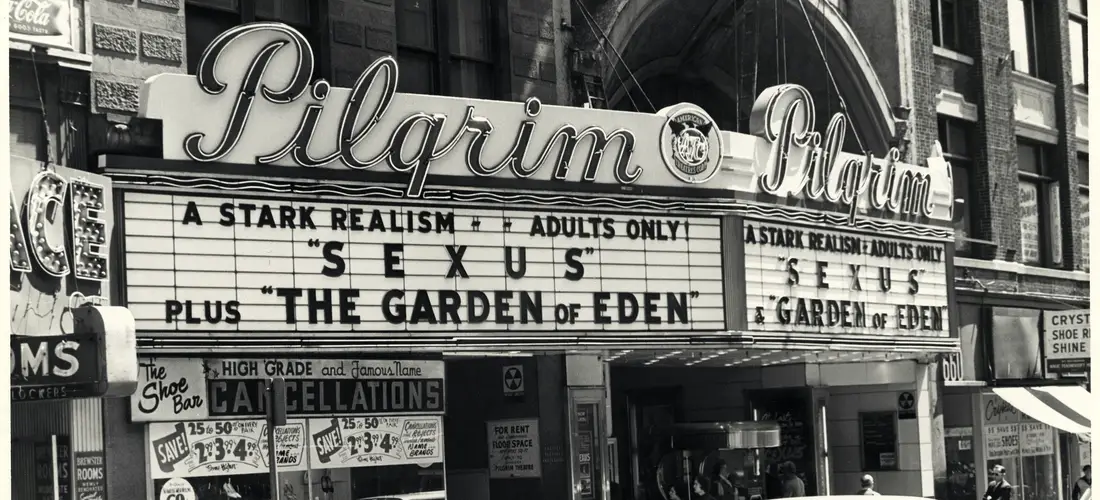

Boston did something unusual with its vice problem. It drew a line around it, put it in the zoning code, and called that a plan. On November 14, 1974, the Zoning Commission approved an adult entertainment zone, and the district on lower Washington Street became the best-known place in the city that nobody wanted next door. Almost all of it is gone. The argument about it is not.
Where it came from
The usual telling goes like this. The Government Center project demolished Scollay Square, a similar red-light district, and lower Washington Street became the center. An author of a book on the district put it in a line the trade paper quoted: you cut off the supply, but you could not cut off the demand.
Historians do not all agree. A Massachusetts Historical Society post on city planning documents says the Washington Street district already existed when Scollay Square fell. The same post says businesses did not move over from the Square. Either way the neighborhood was there before anyone zoned it. The zoning only made it official.
Why a city would zone vice
The reason was legal as much as moral. According to Banker & Tradesman, the district was the city's way to contain a red-light district while complying with a Supreme Court ruling that protected adult businesses under the First Amendment. In plain terms: the city could not ban the businesses, so it could choose where they went.
The head of the Boston Redevelopment Authority, Robert Kenney, said the district would stop strip clubs and adult bookstores from spreading to other neighborhoods. The Globe later wrote that the city codified the district's existence in 1974 by marking out a 5 1/2-acre zone downtown.
Inside the planning world there was a real debate over whether to keep it. A citizens' committee member argued that keeping the trade contained was good for the city. The redevelopment authority's Park Plaza plans called for demolishing parts of the district. For what remained, the same report proposed lighting, mini-parks, sign control and more police. Which camp was right is still argued.
What it was
It was never charming. At its peak in the 1970s, a dozen strip clubs and about three dozen adult businesses worked the area, per a book the Globe cited, including bookshops, movie houses and peep shows. The Globe adds that many of them were linked to organized crime. The paper's own description of the district is not kind: brimming with vice, crime and police corruption.
We are not going to romanticise it, and neither should you. The district sat on the edge of Chinatown, and the families on the other side of the street were the ones who lived with it.
Why it faded
The Globe attributes the decline to political and economic pressures that made the number of adult businesses dwindle over the years, and we have not found a single clean cause in the sources we can open. What the sources agree on is the arithmetic: a district of dozens of businesses is now two clubs.
Those are Centerfolds and the Glass Slipper next door.
What is there now
Walk down LaGrange Street and you are in the last of it. Centerfolds has been on that side street for a quarter-century. Last fall it was trying to move a block away, onto a main route into Chinatown, and Chinatown pushed back hard. In August the Globe reported that the club will stay on LaGrange Street for the foreseeable future. Its owner said it had signed a rent extension with the landlord.
The residents' case is simple. A Chinese Progressive Association organizer told the Globe that people still remembered the old Washington Street. The organizer wants a law that would keep a strip club off streets like Stuart Street in the future. A city councilor, Ed Flynn, has floated a building code change to give neighbors a say before any such business opens.
Chinatown's own history is part of why. The Globe notes that highway projects carved up parts of the neighborhood. A master plan estimated that 91 percent of residents were Chinese in 1990, and only about 55 percent identify as Asian or Pacific Islander now. A neighborhood that has lost that much does not want a second helping of the old problems.
The other side of the argument
The club's general manager does not pretend it is respectable. He calls his kind of business the black sheep of the hospitality sector, but a necessary part of the nightlife fabric. People who work at the club call the comparison to the old district unfair. Several dancers told the Globe they see no reason for the fuss.
On the record the club makes its case in numbers. The Globe reports one licensing violation in the past five years. That violation was a 2022 warning over an armed employee. The venue has a capacity of 394, though seating for roughly 180 to 200. You could argue that is the point of the original zoning idea: contained, licensed and on a side street. The neighbors would answer that they never signed up for it.
Chinatown is not buying the comparison. The head of the Boston Chinatown Neighborhood Center said it is still a neighborhood with families. That is a hard sentence to argue with, and it is the best explanation we can offer for why the old district is not coming back.
What to do with this
If you are here for the history, treat it as context for the neighborhood rather than a destination. Our Downtown guide lists the places we do cover. If you want the other half of the picture, why Boston closes so early and the license cap explain why a license and a zone are the two levers that shaped everything after. The city's earlier attempt to legislate drinking itself away is in Boston under Prohibition.
Go home the straight way. The Last Train page shows tonight's last departures, and getting home after last call covers the rest.